I Am Sober - бесплатное приложение, которое помогает вам вернуть контроль в вашу жизнь.
30 дней без марихуаны
Последнее обновление: 5 октября 2026 г.If you're planning on quitting weed or taking a tolerance break for 30 days, you might be wondering what to expect. You’re in the right place. This guide pairs insights from clinical research with first-month data from more than 201,000 I Am Sober users quitting weed (including edibles, dabbing, and vapes).
Here's the short version. Withdrawal symptoms usually start a day or two after your last use, and peak somewhere between days 2 and 6. This eases within one to two weeks for many people, and some don’t get withdrawal symptoms at all. Sleep is often rough early on and takes longer to settle.
In I Am Sober check-ins, people rated nearly 1 in 4 of their days hard or near impossible in the first three days, but only about 1 in 10 by the last week. By day 30, a lot of people notice clearer thinking, steadier energy, and more money in their bank account.
How your month goes depends on how much you used, how often, and how strong it was, so use the days below as a rough map.
Check this first
For most people, quitting weed is safe to do on your own. Cannabis withdrawal is uncomfortable but isn't considered life-threatening by itself, according to Cleveland Clinic. Talk with a doctor first if you also use alcohol, benzodiazepines, or opioids, or if you live with depression, anxiety, or another mental health condition.
Your first month at a glance
Days 1 to 3
Cravings at your usual times, irritability, restlessness, and the first rough nights. Withdrawal usually begins 24 to 48 hours after your last use.
Days 4 to 7
The tail of the peak window, which runs through about day 6. Vivid dreams, a smaller appetite, and mood swings are common. Your first familiar trigger usually shows up.
Week 2
For many people, the hardest symptoms ease. Mornings get clearer. Sleep can still be uneven.
Weeks 3 and 4
The work shifts from symptoms to routines. Cravings are less frequent, and your patterns are easier to see.
First, a little brain science
Your brain cells communicate using chemical messengers. Some tell a cell to become more active. Others tell it to slow down.
Your body also makes messengers called endocannabinoids, which help fine-tune those conversations. They’re part of a system involved in appetite, memory, mood, and sleep. Think of them as little volume controls. When one brain cell sends a message, the receiving cell can send an endocannabinoid back, telling it to dial down how much it’s releasing. This helps your brain adjust its activity as needed.
THC, the ingredient in weed that gets you high, taps into this system. It activates receiving points called CB1 receptors, which normally respond to your body’s own messengers. That changes communication in several parts of the brain, including areas that help you form memories, process emotions, and coordinate movement. It helps explain why being high can affect everything from how you feel to whether you remember what someone just said.
With frequent use, your brain adapts to that repeated stimulation. Some receptors become less responsive or less available. This is part of tolerance: the same amount of weed may have less effect than it used to.
When you stop, the THC input drops, but your brain doesn’t immediately undo those adjustments. That mismatch helps explain why sleep, appetite, and mood can feel off for a while. The systems that had adapted to regular THC are adjusting again.
The encouraging part is that these adaptations can reverse. Brain-imaging research has found that cannabinoid receptor availability can recover over several weeks without cannabis. That doesn’t give everyone the same recovery schedule, but it does show that your brain can change again after you stop.
Day 1: the first day without weed
What you might feel: Not everyone experiences withdrawal. How much and how often you used can affect how this stretch feels. Withdrawal often starts within 24–48 hours, especially after frequent or heavy use. You might feel restless, anxious, or unusually irritated. Falling asleep can be harder, and you may feel less hungry. Some people also get headaches, sweating, or stomach discomfort.
What’s going on in your body: THC can make you feel sleepy, and regular use can change how your brain regulates sleep. When you stop, that familiar effect is gone while your brain is still adjusting. In a study that measured sleep during withdrawal, daily cannabis users took longer to fall asleep and slept less after stopping. If sleep was difficult before you started using weed, that underlying problem may also still need attention.
Anxiety and irritability: Your endocannabinoid system helps regulate stress and emotional responses. After adapting to regular THC, changes in this signaling appear to contribute to the anxiety, restlessness, and shorter temper that can come with withdrawal. Researchers are still working out the exact pathways in people, but these feelings are recognized withdrawal symptoms.
Appetite: THC can increase hunger and make food feel more rewarding. Stopping removes that appetite boost, and withdrawal can temporarily reduce your desire to eat. You might reach your usual lunchtime and find that nothing sounds good.
What IAS users report: In I Am Sober, the first three days were the hardest of the month. Almost ¼ of rated check-ins called the day hard or nearly impossible. (But don’t get discouraged, for most people it gets much easier). People report being “off” emotionally through this stretch. Annoyed was the most common mood reported in week 1. Tips for getting through it: Day one is mostly about routine. You notice every time slot where weed used to be: after work, after dinner, before bed. Cravings tend to cluster around those times you normally got high.
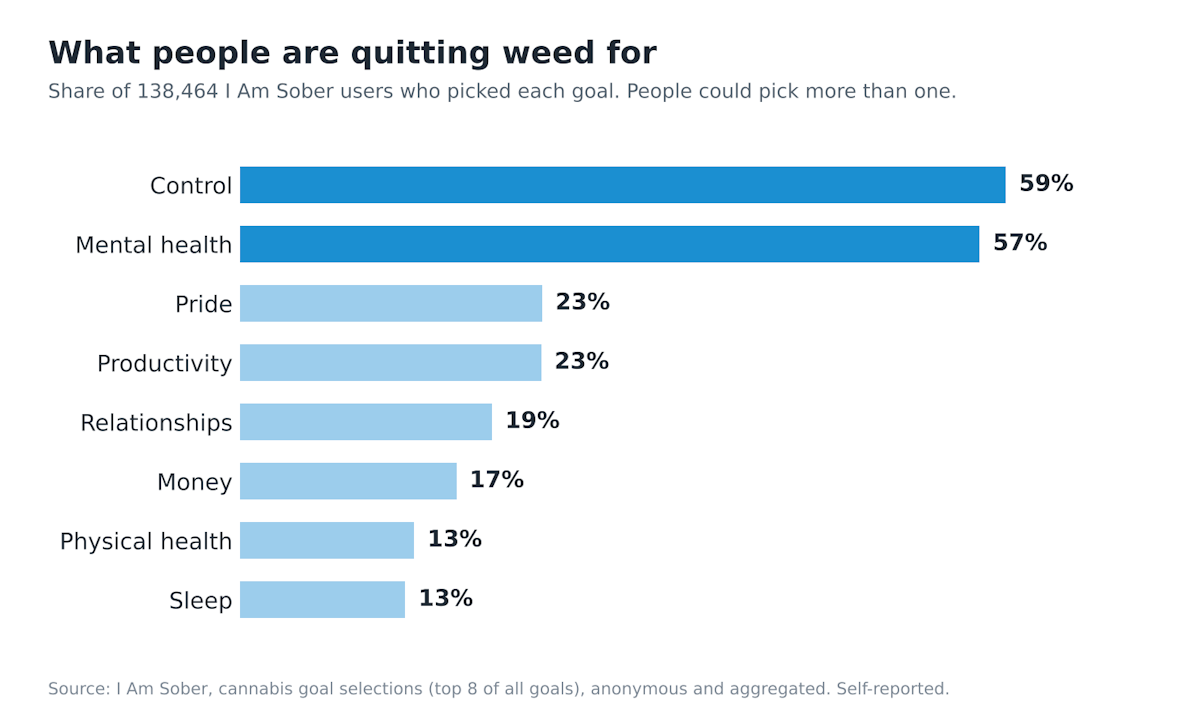
Use today to set things up. Clear out your stash and gear, write down your reason for quitting, and plan something for the hour you'd normally get high. If you're stuck on a reason, borrow one. Here's what 138,464 people in I Am Sober picked when they set goals for quitting cannabis.
In I Am Sober, set your start date so your day count, money saved, and milestones start from day one. Our guide on how to quit weed walks through the full setup.
Days 2 and 3: irritability and rough nights
What you might feel: Trouble sleeping, irritability, anxiety, or low appetite may become stronger now. Many withdrawal symptoms peak somewhere between days 2 and 6. The effects of THC are fading faster than your brain can reverse its adaptations to regular use.
What’s going on in your body: Your dreams may also become unusually vivid. Cannabis can affect REM sleep, a stage when much of our vivid dreaming happens. Some sleep studies have found that REM begins sooner and takes up more of the night during early withdrawal. That may help explain the intense dreams, although sleep changes vary between people.
Sleep may stay broken for a while, and our guide to sleep after quitting weed has a routine to try.
What IAS users report: This is usually where withdrawal shows up. Irritability and a short fuse are among the most common reported symptoms, along with restlessness, anxiety, and trouble falling asleep.
Tips for getting through it: Tell the people you live with ahead of time ("I'm quitting weed, so I might be short with you this week"), get outside and move more, and cut caffeine after noon. When a craving hits, wait 15 minutes and change your setting before you decide anything. More tips on managing cravings in our guide to weed withdrawal symptoms.
Turn progress into something you can see
I Am Sober tracks your sober days, milestones, money saved, and daily pledges so each day gives you something to build on.

Days 4 to 7: still in it, then your first milestone
What you might feel: You may still be in the hardest part of withdrawal, or some symptoms may begin easing. There isn’t one day when everyone turns a corner.
What’s going on in your body: Some aspects of memory may already be improving. THC affects brain systems involved in forming memories. Stopping removes those repeated effects, which may make learning new information easier.
In a study of 88 people ages 16–25, those assigned to stop cannabis improved at learning and remembering words, with most of the improvement happening during the first week. Attention didn’t show the same benefit. Feeling mentally sharper can happen in pieces, even while other parts of the week still feel difficult.
What IAS users report: People often report their appetite is low here, especially if you were used to eating after getting high. Our withdrawal guide covers appetite and weight in more detail.
Mood can swing between fine and irritable within the same day here. The way people describe their days keeps improving through this stretch. From day 3 to day 7, 66% were reported easy or not bad.
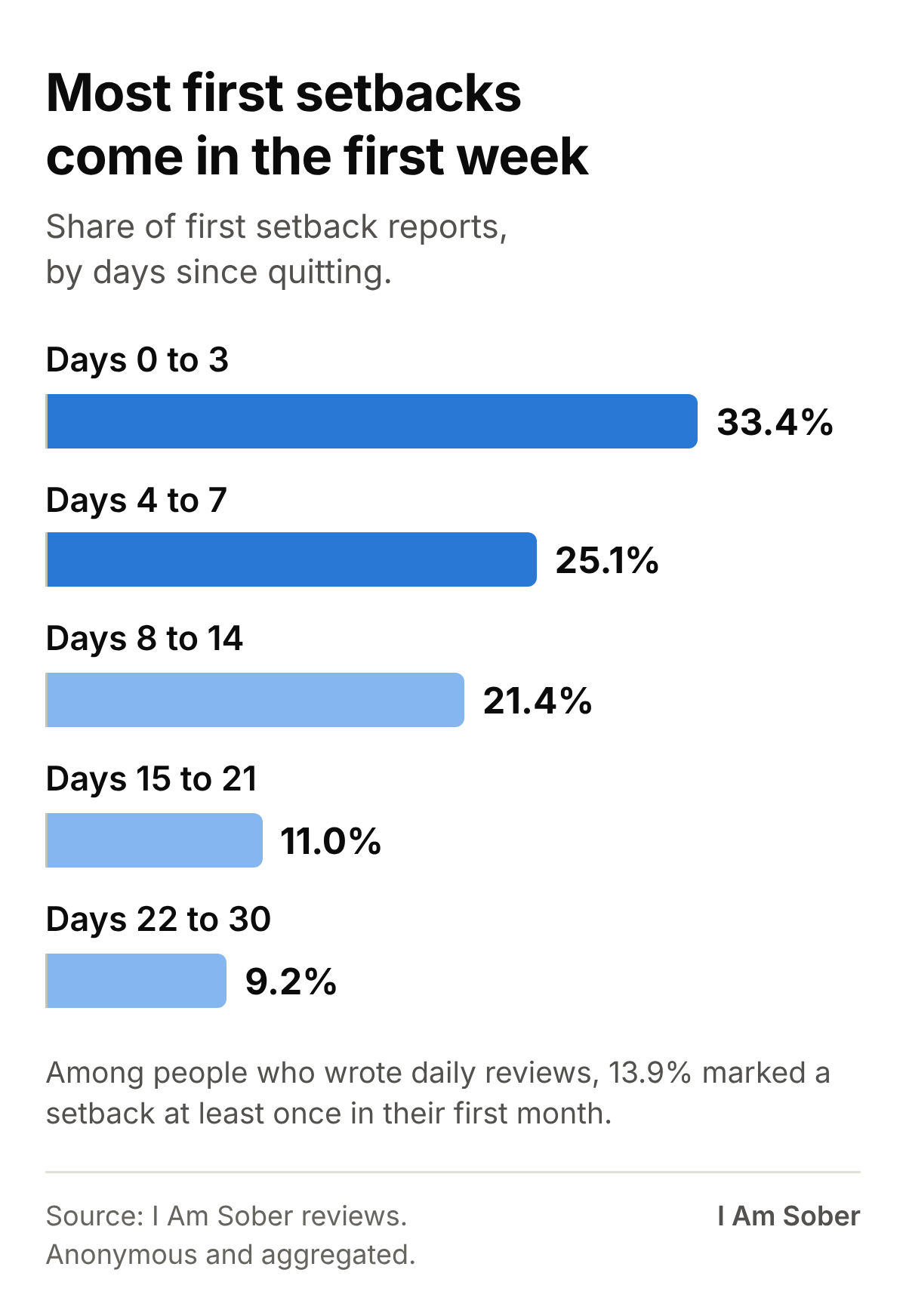
This is also when your first familiar trigger tends to show up pretty strongly: a friend you used to smoke with, a stressful day, an evening with nothing planned. Real talk, setbacks cluster here. Of everyone who reported a setback in the app, 58% marked their first within the first seven days.
Tips for getting through it: Keep your routine small and steady: regular meals, a fixed wake time, and a plan for the evening.
Bonus points for following the daily routine in I Am Sober: a morning pledge, a daily review, daily workbook exercises. It’s free, and it’s helped over a million folks around the world break unwanted addictions.
And finally, take a moment to reflect. One week without weed is worth celebrating!
Week 2 (days 8 to 14): the hardest symptoms ease
What you might feel: For many people, this is where the worst eases. Cleveland Clinic says symptoms can last up to two weeks, though some last three weeks or more in people who used very often. You might feel hungrier or less restless while still having difficult nights. Irritability or low mood can also remain noticeable.
Some people sleep well by now. Others still have restless nights or vivid dreams, and one study by Vandrey and colleagues reported trouble sleeping and strange dreams for up to seven weeks in an outpatient group. If that's you, the sleep guide above has routines that help.
What’s going on in your body: The brain systems involved in appetite, sleep, and emotional responses overlap, but they do different jobs. Reversing one adaptation doesn’t mean every symptom disappears with it. Researchers haven’t established a separate recovery clock for each system. An easier afternoon followed by a rough night can still fit this adjustment period. You don’t have to feel better in every way at once.
What IAS users report: Most people are a lot less irritable, appetite starts coming back, and mornings feel clearer. In I Am Sober, 13.4% of rated check-ins in days 8 to 14 were hard or impossible, and 73% were easy or not bad.
Tips for getting through it: A short nightly review in I Am Sober really helps here. One or two lines about your mood, your sleep, and any cravings add up to a record you can check when the days blur together or if you have a slip up and want to learn from you.
Week 3 (days 15 to 21): building new routines
What you might feel: By now, early withdrawal may have eased considerably. But after heavy use, symptoms can last three weeks or longer. Continuing sleep or mood difficulties deserve attention rather than a deadline to “get over it.”
What’s going on in your body: If you smoked or vaped weed, another change has been underway since you stopped: your airways have had a break from cannabis smoke. Smoke can irritate and inflame the airways, contributing to coughing and mucus. Removing that repeated exposure gives the irritation a chance to settle.
Research links quitting with reductions in cough, mucus, and wheezing over time. It doesn’t establish a specific week when you should notice the difference.
What IAS users report: In I Am Sober, 77% of days in this period were rated easy or not bad.
Tips for getting through it: A new question might start to show up around this time: what do I do with my evenings? If weed was how you unwound, watched movies, or fell asleep, those hours can feel flat or awkward for a while.
Our advice is to put the time and energy you've gotten back into something specific: training, a project, cooking, a class, people you want to see more of. This can really help during this period.
Cravings are usually less frequent by now but can still hit hard in specific situations. When one does, ask what set it off. Our how to quit weed guide covers evening plans and a cravings routine.
Days 22 to 30: the final stretch
What you might feel: By now most folks are starting to really feel the physical and psychological effects of quitting. For most people, withdrawal symptoms are in the past and your sleep should feel more normal.
A month without weed is a milestone, not a deadline for feeling better. If symptoms are severe, worsening, or making daily life hard, talk with a healthcare professional. You deserve support throughout the process.
What’s going on in your body: There’s encouraging evidence about the brain’s ability to readjust. In a small study of men who smoked cannabis daily, reduced cannabinoid receptor availability largely reversed after about four weeks without cannabis.
These receptors help brain cells respond to cannabinoid signals. Their recovery shows that a measurable adaptation to regular use can reverse. It doesn’t mean every brain function has fully recovered or that everyone will feel a particular way by day 30.
What IAS users report: This is the stretch where many people start feeling the change instead of just believing in it. Energy is steadier, thinking is clearer, and your routines hold without as much effort. In I Am Sober, 9.9% of rated check-ins in days 22 to 30 were hard or impossible, and 79% were easy or not bad.
Tips for getting through it: Thirty days is worth celebrating! Look back at your day count and your money saved, and reread your first few daily reviews. The gap between those entries and how you feel today is easy to forget until you see it written down.
By now you know your hard hours, the triggers that catch you, and the tools that work. That's useful whether your next goal is 60 days, 90 days, or something else.
When it's hardest, and when people slip
A generic timeline only goes so far. Here's what people recorded in I Am Sober.
How hard people rated their days
Daily reviews ask people to rate the day from easy to impossible. In the table, "hard" means hard or impossible, and "easy" means easy or not bad.
Days 0 to 2
Hard or impossible 23.5%
Easy or not bad 54.2%
Days 3 to 7
Hard or impossible 17.0%
Easy or not bad 66.0%
Days 8 to 14
Hard or impossible 13.4%
Easy or not bad 72.6%
Days 15 to 21
Hard or impossible 11.3%
Easy or not bad 76.6%
Days 22 to 30
Hard or impossible 9.9%
Easy or not bad 79.2%
The hardest hours are in the evening
Among urges logged by people during their first 30 days of sobriety, evenings carried the most urges and the strongest ones.
Morning (6 a.m. to noon)
Share of logged urges 21.2%
Rated strong 29.7%
Afternoon (noon to 6 p.m.)
Share of logged urges 31.6%
Rated strong 34.7%
Evening (6 p.m. to midnight)
Share of logged urges 37.2%
Rated strong 39.9%
Overnight (midnight to 6 a.m.)
Share of logged urges 10.0%
Rated strong 36.4%
If you plan one stretch of your day, plan 6 p.m. to midnight. Our how to quit weed guide has an evening plan and a cravings routine you can start with.
How much you used before quitting
People who used more before quitting marked more setbacks in week one. Frequency is self-reported (days per week times uses per day). Don’t get discouraged if you have a setback. Just learn from it, and try again.
Used 1 to 6 times per week
6.8%
Used 7 to 20 times per week
9.6%
Used more than 21 times per week
12.9%
When setbacks happen
What helps people keep going
People who built these habits in their first 30 days were far more likely to still be hitting milestones in month 2.
Make a daily pledge
About 60x times more likely to still be logging milestones in month 2
Add notes to your daily review
About 17x times more likely to still be logging milestones in month 2
Complete a workbook activity
About 12x times more likely to still be logging milestones in month 2
Post or comment in the community
About 9x times more likely to still be logging milestones in month 2
Complete a coping exercise
About 8x times more likely to still be logging milestones in month 2
Log an urge
About 7x times more likely to still be logging milestones in month 2
I Am Sober’s features are designed to help you stay sober longer. Some of the results above are best described as motivation, since committed people tend to adopt more routine around quitting. These habits are cheap to try, though, and most take a minute or two per day.
Benefits of quitting weed
The benefits people mention most are sharper memory, clearer mornings, steadier energy, money and time back, and, if you smoked, easier breathing. How much you notice depends on how long and how heavily you used.
-
Sharper memory. In the Massachusetts General Hospital study, memory for new information improved within a month of stopping, mostly in the first week.
-
Mood that holds up. In a 2021 study, young people who used weekly and were assigned to stop for four weeks had no more anxiety or depression symptoms than those who kept using. The first check-in came at week one, so it may have missed the roughest days.
-
More days that feel like a win. In I Am Sober, "accomplished" was the most common mood from week 2 on, on days without a logged urge or setback. It grew from 15% of mood-tagged check-ins in week 1 to 26% in week 4.
-
Lower tolerance. In a small imaging study of men with cannabis dependence, cannabinoid receptors began recovering within two days of stopping and, after 28 days, showed no measurable difference from non-users. It's one small study, so treat it as a rough guide to how fast tolerance can reset.
-
Clearer mornings and steadier energy, especially once your sleep settles.
-
Money back. Check the total in I Am Sober at day 30 and decide what it's for.
-
Time back. The hours that went to using, getting it, and recovering.
-
Easier breathing, if you smoked. The National Academies' 2017 evidence review found moderate evidence that quitting cannabis smoking improves respiratory symptoms like chronic cough and phlegm. Those studies followed people for months to years, so day 30 may be early to notice a change.
-
A clearer read on yourself. Your triggers, your feelings, and what you want to do with your time.
If you still feel bad
Some symptoms outlast the first two weeks, especially in heavy users. Sleep trouble, low mood, and anxiety can linger, and some symptoms can last three weeks or longer according to the Addiction review.
That's a known pattern, so one slow week doesn't mean your quit has stalled.
Talk to a doctor or counselor if:
-
Sleep or mood problems last longer than a few weeks.
-
Symptoms get in the way of work, school, or relationships.
-
You had anxiety or depression before you started using, or they're getting worse.
-
You keep going back to weed to stop the symptoms.
-
You also use alcohol, benzodiazepines, or opioids.
A few weeks of mood and sleep entries from I Am Sober give the appointment something concrete to work with.
NIDA lists cognitive behavioral therapy, motivational enhancement therapy, and contingency management as effective for cannabis use disorder, and there are no FDA-approved medications for it yet. In the U.S., the SAMHSA National Helpline (1-800-662-4357) is free and confidential. If you're having thoughts of harming yourself, call or text 988 or your local emergency number right away.
If you use before day 30
If you slip, don’t get down on yourself. Every day you've already put in still counts. You're also in good company. Among people who wrote daily reviews, about 1 in 7 marked a setback in their first month, and two-thirds of them came back within 30 days.
Walk it back while it's fresh. What day and time was it? What were you feeling, and who were you with? Was there a craving earlier that you pushed through or ignored? Was there still a cart or an edible somewhere in the house?
In I Am Sober you can log the slip, add a note about what led to it, revisit your reasons, and lean on the community. Then change one thing about the plan and pick your next start. It can be tonight.
Start your 30 days
-
Pick a start date within the next week and write down a specific reason.
-
Clear out your stash, carts, edibles, and gear.
-
Plan the hours that are hardest: evenings, weekends, bedtime.
-
Set up a sleep routine before day one.
-
Tell one person, and tell them what you need from them.
Our how to quit weed guide covers each step in detail, and the marijuana support hub lists every guide by stage.
Frequently asked questions
What happens after 30 days without weed?
Withdrawal has usually eased, though sleep may still be settling. Many people notice clearer thinking, better memory, steadier energy, and more money. In one small brain imaging study, cannabinoid receptors showed no measurable difference from non-users after 28 days.
What are the benefits of quitting weed?
The most common are sharper memory, clearer mornings, steadier energy, saved money and time, and, for people who smoked, easier breathing over time.
What is the hardest day without weed?
Symptoms usually peak between days 2 and 6, and day 3 is often named as one of the hardest. Familiar triggers, especially in the evening, can be just as hard.
What happens on day 3 without weed?
Day 3 is where symptoms often peak. Expect irritability, restlessness, anxiety, trouble sleeping, and strong cravings at your usual times. Cleveland Clinic says symptoms typically peak by around day three, and the broader research puts the peak between days 2 and 6.
Is day 3 the hardest? For many people, yes. Cleveland Clinic says symptoms typically peak by around day three, and the broader research puts the peak between days 2 and 6. If today feels rough, you're probably near the top of it.
Why is day 4 harder than day 3?
It can be. The peak window runs from about day 2 to day 6, so symptoms don't always fall in a straight line. Sleep, dreams, and mood often stay rough through day 5 or 6.
What happens in the first week without weed?
Expect irritability, restlessness, cravings, trouble sleeping, vivid dreams, and a smaller appetite. Most of it peaks in the first week and eases over the next one to two.
How long does it take for sleep to go back to normal after quitting weed?
It varies. Many people sleep better within a few weeks, but trouble sleeping and vivid dreams can last longer in heavy users, up to about seven weeks in one outpatient study.
Is two weeks without weed enough to feel a difference?
Many people feel a difference by two weeks, as the strongest symptoms ease and mornings get clearer. Memory gains showed up as early as the first week in one study of young people.
What if I use before day 30?
Write down what led to it, change one thing in your plan, and pick your next start. The days before the slip still count.
How can I track 30 days without weed?
I Am Sober lets you set your start date, count weed-free days, track money saved, make a daily pledge, log cravings and moods, and mark milestones as you reach them.
Sources:
-
I Am Sober, cannabis first-month aggregate analysis, 2 Oct 2026. Onboarding 9 Mar to 1 Sep 2026, events through 1 Oct 2026. Anonymous and aggregated; self-reported app activity.
-
Cleveland Clinic, Marijuana (Weed) Withdrawal. https://my.clevelandclinic.org/health/diseases/marijuana-weed-withdrawal
-
Connor JP, et al. Clinical management of cannabis withdrawal. Addiction, 2022. https://onlinelibrary.wiley.com/doi/10.1111/add.15743
-
Cannabis and sleep architecture: A systematic review and meta-analysis. Sleep Medicine Reviews, 2025. https://www.sciencedirect.com/science/article/pii/S1087079225001170
-
Schuster RM, et al. One Month of Cannabis Abstinence in Adolescents and Young Adults Is Associated With Improved Memory. J Clin Psychiatry, 2018. Summary: https://news.harvard.edu/gazette/story/2018/10/one-month-of-abstinence-from-cannabis-improves-memory-in-adolescents-young-adults/
-
Vandrey R, et al. Sleep disturbance and the effects of extended-release zolpidem during cannabis withdrawal. https://www.med.upenn.edu/cbti/assets/user-content/documents/nihms273324.pdf
-
Cooke ME, et al. Assessing Changes in Symptoms of Depression and Anxiety During Four Weeks of Cannabis Abstinence Among Adolescents. Front Psychiatry, 2021. https://pubmed.ncbi.nlm.nih.gov/34276449/
-
D'Souza DC, et al. Rapid changes in cannabinoid 1 receptor availability in cannabis-dependent male subjects after abstinence from cannabis. Biol Psychiatry Cogn Neurosci Neuroimaging, 2016. https://doi.org/10.1016/j.bpsc.2015.09.008
-
National Academies of Sciences, Engineering, and Medicine. The Health Effects of Cannabis and Cannabinoids, 2017, Chapter 7: Respiratory Disease. https://www.nationalacademies.org/read/24625/chapter/9
-
NIDA, Cannabis (Marijuana). https://nida.nih.gov/research-topics/cannabis-marijuana
-
SAMHSA National Helpline. https://www.samhsa.gov/find-help/helplines/national-helpline
I Am Sober - бесплатное приложение, которое помогает вам вернуть контроль в вашу жизнь.