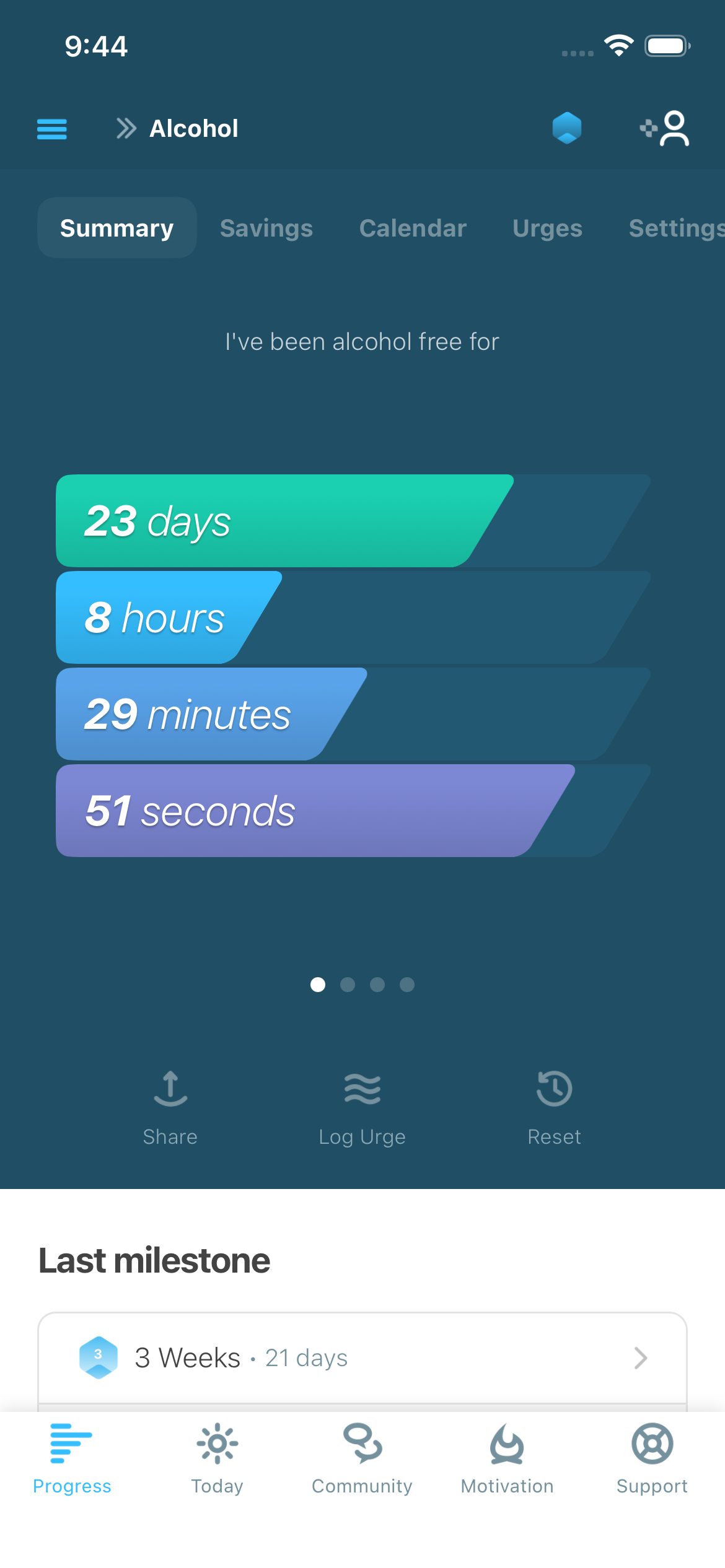
I Am Sober is a free app that helps you get some control back in your life.
Is Beer Addictive? Signs Your Beer Drinking Has Become a Problem
Last updated: August 25, 2026Short answer: Yes, beer can be addictive because it contains alcohol. Alcohol use disorder isn't defined by whether you drink beer, wine, or liquor — it's defined by the pattern: losing control over how much you drink, craving alcohol, needing more to feel the same effect, withdrawal when you stop, and continuing to drink despite the consequences. Beer can feel lower-risk because it's everywhere and socially accepted, but a regular beer habit can still become a problem.
If you're reading this because your own beer drinking has started to feel less like a choice and more like a routine you can't easily skip, you're not being dramatic, and you're not being judged here. The goal of this guide is simple: to help you see your pattern clearly, understand what the signs actually are, and give you a concrete way to find out whether anything needs to change.
If beer is starting to feel harder to control, you don't have to guess.
You can start by tracking beer-free or alcohol-free days with I Am Sober's alcohol sobriety tracker, log cravings as they hit, and watch whether your pattern is shifting over a couple of weeks. Seeing it is the first step to changing it.
Why Beer Can Become Addictive
The reason beer can become a problem has nothing to do with the fact that it's beer. It's the alcohol.
Alcohol affects the brain's reward system. When you drink, it triggers a pleasant, relaxing response, and your brain takes note. Over time, repeated drinking can reinforce the urge to do it again — especially when it's paired with a reliable cue like the end of a workday, a game on TV, or the moment you walk in the door at night. The behavior gets easier to repeat and harder to skip.
A few things tend to drive that loop:
-
Reinforcement. The relief or reward you feel makes your brain want to repeat it.
-
Tolerance. Drink regularly and your body adapts, so you may need more beer than before to feel the same effect.
-
Coping. Many people drink to take the edge off stress, anxiety, boredom, loneliness, social discomfort, or trouble sleeping. When beer becomes the main tool for managing those feelings, the habit deepens.
According to the National Institute on Alcohol Abuse and Alcoholism (NIAAA), alcohol use disorder (AUD) is a medical condition where someone has difficulty stopping or controlling their drinking despite negative consequences, and the risk is shaped by genetics, mental health, stress, trauma, and environment — not by which drink you happen to prefer.
Beer Is Still Alcohol
There's a common belief that beer is the "safer" choice because it isn't liquor. The body doesn't see it that way. It responds to the alcohol itself, not the category of drink.
In the U.S., a standard drink is defined by the amount of pure alcohol it contains, not the size of the glass. NIAAA defines one standard drink as a 12-ounce beer at about 5% alcohol. That's the benchmark a lot of guidance is built around — but it's also where a lot of people underestimate themselves, because plenty of beer isn't poured in 12-ounce, 5% servings.
How Many Drinks Are in Beer?
Here's roughly how it adds up:
-
12 oz of 5% beer: about 1 standard drink
-
16 oz of 5% beer (a pint or tall can): more than 1 standard drink
-
16 oz of 8% beer (many craft and IPA pours): closer to 2 standard drinks
-
22 oz high-ABV bottle: can hold multiple standard drinks on its own
So "I only had five beers" can quietly mean five drinks — or it can mean eight or nine, depending on the ABV and the pour. Craft beers, tall cans, large restaurant pours, and high-ABV styles can each count as more than one standard drink. The number on the can matters as much as the number of cans.
Is Drinking Beer Every Night a Problem?
Not automatically. A beer at night isn't a diagnosis, and nightly drinking doesn't mean you have alcohol use disorder. But it's worth paying attention to if the habit feels automatic, is hard to skip, has been creeping up over time, or has become tied to your sleep, stress, or mood.
A few signals that a nightly beer might be shifting from habit toward problem:
-
You feel irritated or anxious when you can't have one.
-
You tell yourself "just one" and regularly end up having more.
-
You drink on nights you'd decided to take off.
-
You feel like you need it to relax, sleep, or feel normal.
-
People close to you have started to comment on it.
-
You downplay or hide how much you actually drink.
-
You wake up regretting what you said, did, or spent.
-
You keep going even when it's affecting your health, work, or relationships.
None of these means you've "failed." They're information. And the cleanest way to get that information is to test it: try tracking your usual beer window for two weeks. Notice your cravings, your mood, your sleep and whether skipping a night feels easy or genuinely hard. That contrast usually tells you more than any single checklist can. (If you want help breaking the after-work or after-dinner pattern specifically, this guide on how to stop evening drinking is a good next read.)
How Many Beers Is Too Many?
The Centers for Disease Control and Prevention (CDC) uses a few standard definitions, measured in standard drinks:
-
Moderate drinking: up to 1 drink per day for women, up to 2 drinks per day for men.
-
Binge drinking: 4 or more drinks for women, or 5 or more for men, during a single occasion.
-
Heavy drinking: 8 or more drinks per week for women, or 15 or more per week for men.
Two important caveats. First, these numbers describe drinking patterns and risk levels only. They don't diagnose alcohol use disorder. Second, they cut both ways: you can drink under these thresholds and still have a problem if you can't control it or you keep drinking despite consequences, and you can carry real health risks from alcohol even if you'd never call yourself addicted. The thresholds are a useful gauge, not a finish line.
Signs Beer Drinking Has Become a Problem
When clinicians look at problem drinking, they're not asking whether you drink beer, they're looking at the criteria for alcohol use disorder. Translated into plain, beer-specific terms, those signs look like this:
-
You drink more beer than you meant to.
-
You've tried to cut back and couldn't.
-
You spend a lot of time drinking, recovering, or arranging your evenings around it.
-
You crave beer or think about it often.
-
It's interfering with work, school, family, or responsibilities.
-
You keep drinking even when it causes conflict.
-
You've given up activities you used to enjoy so you can drink instead.
-
You drink in situations where it isn't safe.
-
You keep drinking even when it's worsening your anxiety, depression, sleep, or health.
-
You need more beer than you used to in order to feel it.
-
You feel withdrawal symptoms when you stop.
The more of these you recognize, the more it's worth taking seriously, and worth talking to a healthcare professional about.
A note on safety: If you drink heavily every day, or you've noticed withdrawal symptoms when you go without, talk with a doctor or another healthcare professional before you stop suddenly. Alcohol withdrawal can be dangerous and sometimes requires medical supervision. You can read more about what to expect with alcohol withdrawal, but it's not something to manage alone if your drinking is heavy or daily.
Why Beer Problems Can Be Easy to Miss
Part of what makes a beer habit hard to see is that the culture around it is so warm and so ordinary. Beer shows up at the cookout, the ballgame, the concert, the restaurant, and the after-work wind-down. "I need a beer" is practically a punchline. None of that is a character flaw, and none of it needs to be shamed.
But that same normalcy is exactly what makes the pattern easy to overlook:
-
Beer looks more casual than liquor, so a few feels like "nothing."
-
Lower-ABV options make it easy to drink several without registering the total alcohol.
-
Craft beer culture can normalize high-ABV styles and big pours, so the math creeps up.
-
Because it's social and everyday, the routine can build for years before anyone questions it.
The point isn't to ruin anyone's hobby or vilify a Saturday afternoon. It's awareness. When you can actually see the pattern — how often, how much, and why — you get to decide what you want to do with it.
What to Do If You Think Beer Is Becoming a Problem
You don't need to overhaul your life this week. A clear, low-pressure next step is usually enough to get real answers:
-
Track it for one week. Count how many beers you drink and note the ABV and size, not just the number of cans.
-
Note when and why. Watch for the cues: time of day, mood, place, people.
-
Try alcohol-free days. See what happens to your sleep, mood, and cravings, and notice how hard or easy it feels.
-
Find your usual window. Most beer habits live in a predictable time slot. Name yours.
-
Decide on a goal. Cutting back and quitting are both valid. Pick the one that fits where you are.
-
Tell one person you trust. Saying it out loud makes it real and gives you support.
-
Get medical advice if you drink heavily, have withdrawal symptoms, or can't cut back safely.
-
Consider further support like therapy, mutual-support groups, or medication if you need it. The NIAAA Alcohol Treatment Navigator can help you find professional options, and the CDC's Check Your Drinking tool is a simple way to start a self-check.
If you'd rather quit outright, how to stop drinking walks through the bigger picture, and many people find an alcohol cravings plan makes the early days far more manageable.
I Am Sober is built for this exact first step. You can set a daily pledge, track beer-free or alcohol-free days, log cravings as they happen, save your reasons for changing, and celebrate milestones along the way. It isn't a substitute for treatment , and it isn't enough on its own if you're dealing with withdrawal or severe alcohol use disorder, but it's a practical way to make an invisible routine visible.
See what 280,000+ people reported in their first month without alcohol
This free guide is built from real first-month check-ins by more than 280,000 I Am Sober members quitting or cutting back on alcohol. Select how often and how much you drink to see when hard days, urge moments, restarts, and mood shifts most often showed up for people with similar habits.
How I Am Sober Can Help With a Beer-Free Goal
If beer has become part of your nightly routine, visible progress is one of the most useful things you can have. I Am Sober is designed to make the pattern obvious and the change trackable:
-
Daily pledge — make a commitment each day, ideally before your usual beer window.
-
Sober day counter — watch beer-free or alcohol-free days add up.
-
Your reasons — save why you're cutting back or quitting and revisit them when the urge hits.
-
Cravings and triggers — log urges as they happen and see the situations that set them off.
-
Money saved — see what you're keeping by not buying beer.
-
Milestones — mark 7 days, 14 days, 30 days, and beyond. (Curious what a reset feels like? Here's what 30 days without alcohol can look like.)
-
Community — connect with people changing their own alcohol habits, on your terms and at your own pace.
If beer has become part of your nightly routine, those small daily signals like a pledge kept, a craving logged, or a streak growing make it much easier to see whether the habit is actually changing. Start tracking your first beer-free week, set up an alcohol-free tracker, or simply log cravings during your usual beer window and see what the pattern tells you.
And if you're weighing beer against other drinks in your life, it's worth understanding beer and wine addiction together because, again, the common thread is the alcohol, not the bottle it comes in.
Ready to make a change? We've got you!
I Am Sober is a sobriety and habit change app that helps people track their progress, reach new milestones, and build the daily support system they need to keep going.
FAQ
Is beer addictive?
Yes — beer can be addictive because it contains alcohol. The risk depends on how much you drink, how often, and how quickly, along with factors like genetics, mental health, stress, trauma, and environment. The beverage type isn't the issue; the alcohol and the pattern are.
Can you get addicted to beer but not liquor?
Clinically, there's no separate "beer addiction" — the concern is alcohol use disorder. A person can develop alcohol-related problems even if beer is the only thing they ever drink, because the body responds to the alcohol regardless of its source.
Is drinking beer every night a problem?
It can be. A nightly beer isn't automatically a disorder, but it's worth examining if it feels automatic, is hard to skip, has been increasing over time, or is affecting your health, relationships, work, sleep, or mood. Trying a few alcohol-free nights is a quick way to see how strong the habit really is.
How many beers is too many?
The CDC defines binge drinking as 4 or more drinks for women or 5 or more for men in a single occasion, and heavy drinking as 8 or more drinks per week for women or 15 or more per week for men. But those numbers don't tell the whole story — control, cravings, and consequences matter just as much as the count.
What are signs of beer addiction?
Common signs include drinking more than you planned, failed attempts to cut back, frequent cravings, needing more to feel the same effect (tolerance), withdrawal symptoms when you stop, hiding how much you drink, and continuing to drink despite the problems it causes.
Why is it hard to stop drinking beer?
Beer often gets tied to routines, stress relief, social settings, sleep, and reward — and for heavier drinkers, to avoiding withdrawal. That makes the habit physical, emotional, and environmental all at once, which is why willpower alone often isn't enough and a plan helps.
Should I stop drinking beer suddenly?
If you drink heavily or daily, or you've had withdrawal symptoms when you cut back, talk with a healthcare professional before stopping suddenly. Alcohol withdrawal can be dangerous and sometimes needs medical support. For lighter, occasional drinking, cutting back or stopping is generally much lower risk.
Can an app help me stop drinking beer?
An app can't replace medical care or treatment, but it can make the work more doable. I Am Sober helps you track beer-free or alcohol-free days, log cravings and triggers, save your reasons for changing, and hit milestones — turning a vague sense of "I drink too much" into something you can actually see and act on.
This article is for general information and isn't a substitute for medical advice. If you're concerned about your drinking — especially if you drink heavily or daily — talk with a qualified healthcare professional.
Sources: National Institute on Alcohol Abuse and Alcoholism (NIAAA), Understanding Alcohol Use Disorder; NIAAA, What Is a Standard Drink?; Centers for Disease Control and Prevention (CDC), Alcohol Use and Your Health; NIAAA Alcohol Treatment Navigator; CDC Check Your Drinking.
I Am Sober is a free app that helps you get some control back in your life.
Relevant articles

30 Days No Alcohol: Timeline, Benefits, and Tracker

Can the Liver Heal Itself? Alcohol Damage and Recovery

Does Non-Alcoholic Beer Have Alcohol? What It Means for Sobriety
Sober October: How to Do It, Plus the Best App to Track It
Sober Curious: What It Means and How to Try Drinking Less